
Folder Lock enables you to encrypt any number data contained in your files, folders, and drives. Using Military Standard 256-bit AES on-the-fly encryption to protect your important files, Folder Lock encrypts your important data and gives you a complete peace of mind when it comes to keeping your files safe. Folder Lock encrypts and decrypts your files on-the-fly i.e. the contents of your files are loaded in memory instead of your computer's hard drive. This guarantees that your data is unrecoverable from the hard drive, and is, therefore, faster than normal encryption and decryption as this method does not decrypt everything in your hard drive. Folder Lock also offers additional benefits over many other similar products in the market including Secure Backup, which backs up all your encrypted files to your secure backup account, re-adjust Locker size automatically, and be portable and secured at the same time.
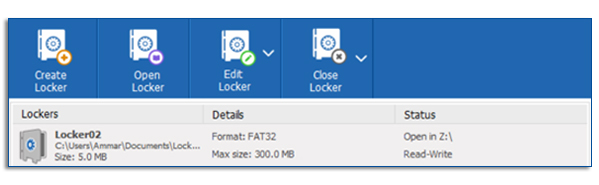
To encrypt data with Folder Lock is a breeze, and the program has been developed so that all processes are run on-the-fly and behind the scene. To start encrypting your data, you will need to create a Locker. To do this, go to the 'Encrypt Files' feature in Folder Lock and click on the 'Create Locker' button on the top menu. (see image below)

The 'Create Locker' button will create your Locker, which is an encrypted storage file, uses government-level 256-bit AES encryption algorithm to store and protect your important files and folders, can store any amount of data, can be added to the 'Secure Backup' service in Folder Lock, and can be moved to any portable drive, shared folders, network mapped drives & can be accessed directly from these locations. Furthermore, since Lockers are undeletable without a correct password (depending on your security settings), you can be rest assured that whatever files you dump into them will remain confidential, theft-proof, and loss-proof.
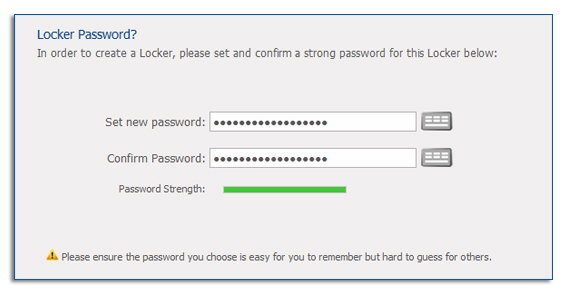
After you click on the 'Create Locker' button, the wizard starts with a request to input your 'Locker Name' and 'Locker Path'. By default, the Locker name (e.g. Locker01) and the Locker path will be provided which is 'My Documents' folder in your PC. Select the 'Locker Name' & 'Locker Path' and then click 'Next' to proceed. In the 'Set Locker Password' field (see image below), you will need to enter a password for your Locker. Please note that THIS PASSWORD CANNOT BE RECOVERED.

Please be advised to keep the following in mind for the Locker Password:
An on-screen password strength meter will show you the strength of your password, and you will have the option to enter your password using the Virtual Keyboard available, which mitigates the risk of eavesdropping on your keyboard's Keystrokes by Keystroke recorders or Keyloggers.
After you have set and confirmed your Locker Password, click 'Next' to continue to the next step where you need to specify what type of Locker you wish to create. You have an option of two unique Locker types (see image below): 1) Portable Locker; and 2) Basic Locker.

The Portable Locker is a Locker that supports secure backups to your own personal online digital storage account, whereas, the Basic Locker is a Locker that does not support secure backups, but will allow you to encrypt data of any size.
Please note that when you create a Locker using Portable Locker type, If you select a USB drive or anyother external drive as your Locker destination, it will create a Locker file as well as Folder Lock portable. exe file to run the Locker at any computer without installing Folder Lock on it.
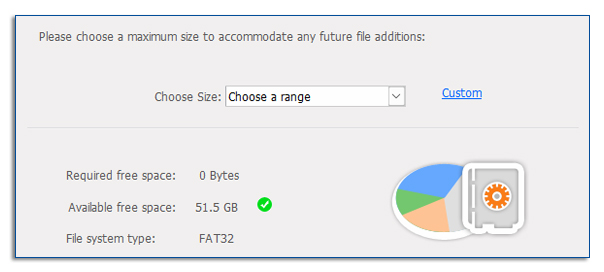
Once you have selected your Locker type, click 'Next' to proceed further and select the data size you wish to protect in your Locker (see image below). PLEASE KEEP IN MIND THAT YOU WILL NOT BE ABLE TO CHANGE YOUR LOCKER DATA SIZE IN THE FUTURE, therefore, it is strongly recommend that you select a maximum size for your data to allow for any future data protection needs.

You can choose between the preset data sizes available or you may enter your own Locker data size by clicking on the 'Custom' link. Do keep in mind, however, to set a Locker data size between 300 MB to 2 TB for the Portable Locker, and a Locker size between 20 MB – 14 TB for the Basic Locker. When done, the wizard will display the size of the Locker file that will be required to create your Locker, as well as the available disk-space. Click on the 'Next' button to start the Locker creation process. The wizard displays a progress bar that will show until the Locker creation process is completed.
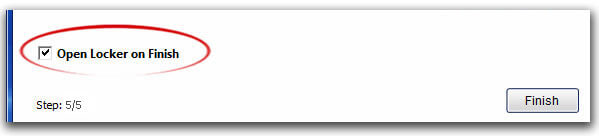
After your Locker has been successfully created, the wizard will display Locker Name, Locker Path, Locker Size, and the Locker Type information for your new Locker as well as give you the option to open the Locker after you click on the 'Finish' button (see image below).

To open the Locker after you click on the 'Finish' button, simply select the checkbox next to Open Locker on Finish to do this. This will mount and open the newly created Locker on a drive. The default drive on which the Locker mounts is Z:\ (see image below).

From the list of Lockers in the main Encrypt Files feature, you may then select your Locker and start adding your data to it. However, if you do not wish to open the newly created Locker at this time, simply remove the check from the checkbox, and click on the 'Finish' button to close the wizard, and you will be taken to the Locker list in the main 'Encrypt Files' interface, which will also show your newly created Locker.
From the Locker List, you can then Open, Edit, Copy/Move, and Delete your Locker. Optionally, you may also add this Locker to the 'Secure Backup' list.
You can encrypt data in the following ways from within Folder Lock: If Your Locker Is Not In The Encrypt Files List (see image below)

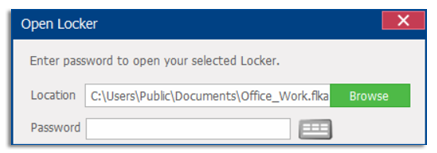
To encrypt data with Folder Lock if your Locker is not listed in the Encrypt Files list, go to the Encrypt Files module in Folder Lock, and click on the 'Open Locker' button on the top menu to locate and select your Locker from the your PC. Click on the 'Browse' button in the 'Locker Location' field to locate your Locker. Next, enter the Locker password in the 'Enter Password' field.
Once you have entered all the required details, click on 'Open' to open your Locker in Windows Explorer. Simply select your files that you wish to encrypt and add it to the Locker by drag-n-drop or by the copy/paste method. Close the window and that is all there is to it. Your file is now encrypted with military standard 256-bit encryption.
If Your Locker Is Closed And Listed In The Encrypt Files List(see image below)

To encrypt data with Folder Lock if your Locker is listed in the Encrypt Files list and displays the Closed status, then go to the Encrypt Files module in Folder Lock and select your Locker. Next, click on the 'Open Locker' button on the top menu and in the popup window, enter the Locker password in the 'Enter Password' field. Click on 'Open' to open your Locker in Windows Explorer. Simply select your file that you wish to encrypt and add it to the Locker by drag-n-drop or by the copy/paste method. Close the window and that is all there is to it. Your file is now encrypted with military standard 256-bit encryption.
If Your Locker Is Open And Listed In The Encrypt Files List (see image below).

To encrypt data with Folder Lock if your Locker is listed in the Encrypt Files list and displays the Opened status, then go to the Encrypt Files module in Folder Lock and select your Locker. Next, click on the 'Explore' button placed at bottom-left of the list and in the Locker window that pops up, simply select your files that you wish to encrypt and add it them the Locker by drag-n-drop or by the copy/paste method. Close the window and that is all there is to it. Your file is now encrypted with military standard 256-bit encryption.