
‘You have received a Gift Card from your friend’, sounds alluring, isn’t it?
For someone who loves to receive gifts and greeting cards from his/her friends, a surprising gift card materializing from the thin air is, with no doubt, an excitingly enticing discovery, which is exactly what these internet bad guys have in their conniving minds too.
Starting from the news of a recent malware attack from scary cybercriminals, we’ll take you to the immediate remedy available to curb the chances of a successful spam attempt.
Email users have reported a recent malware attack spammed out faking a gift card from a friend. Hitting all around the world, infecting various inboxes with a Trojan horse attached as .PIF file in the email, this malware attack has been cleverly crafted to infect unprotected Windows computers by infusing the Trojan Horse into the system.
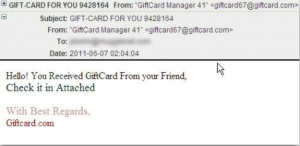
Here are the details and the face of the email that email users have been receiving.Subject: GIFT-CARD FOR YOU [number]Attached file: gift-card.pifMessage body:
Hello! You Received GiftCard From your Friend,
Check it in Attached
With Best Regards,
Giftcard.com
It has also been reported that another version of the similar attack has been widespread as well. The only difference in the other version is of wording and typographical changes.
Have a look!
Subject: GIFT-CARD From Your Friend [number]
Attached file: gift-card.pif
Message body:
Hi! You Received GiftCard From your Friend,
Check it in Attached
With Best Wishes,
giftCard.com
For someone who is not technically aware enough to sniff something fishy in the bottom, this email may appear like a normal email informing the user that he has been gifted with a greeting card, or stuff on the same line. Even if you are a proactive internet user and are familiar with attacks like these, the .PIF extension file will get you completely hoodwinked. Generally, in malware attacks of the same kind, the Trojan horse is enveloped in a .exe file or the exe file of the malicious software is disguised as a word file.
Giving this malware attack entirely a new yet more deceiving form, these bad guys have used a .PIF extension file instead of the conventional one. For now, what we advise you to do is to hold the URGE to click on that attached file, no matter how enticing it looks to you.
DON’T CLICK IT.
If you can’t give them the taste of their own medicine, you can at least put a full stop to their malicious activities. That’s right. With some vigilance on your part, followed by few of our tips and software programs, you can strengthen your defense system in a most reliable way ever.
Stay with us and find more about keeping your system secure and safe.
What To Say When You Receive A Gift Card?
Thank you so much for the gift card! I really appreciate your thoughtfulness.
How Do You Tell Someone You Got Them A Gift Card?
I got you a gift card as a special surprise! I hope you enjoy it!
What Does The Gift Card Code You Entered Has Already Been Applied To Your Account Mean On Amazon?
This message means that the gift card code you entered has already been applied to your Amazon account. This could be a result of someone else using the code before you, or it could be that you already applied the code to your account.
What Should I Write On A Gift Tag?
On a gift tag, you can write a heartfelt message to the recipient, such as “Thank you for being a wonderful friend” or “Wishing you all the best.” You can also include a special message that is meaningful to your relationship, such as “I’m so grateful for our friendship” or “You always make me smile.”